

Relied on by
what a single won claim can recover
a battery history the manufacturer's servicing cannot wipe
evidence from before any problem starts, ready for a claim
Assets & compliance monitors every battery against the commitments in the manufacturer's contract, including mileage, energy throughput and state of health, independently of the onboard systems. The contracts view holds every support agreement and its annex conditions. The usage view shows how much of each allowance a vehicle has used, and flags vehicles near or past a limit.
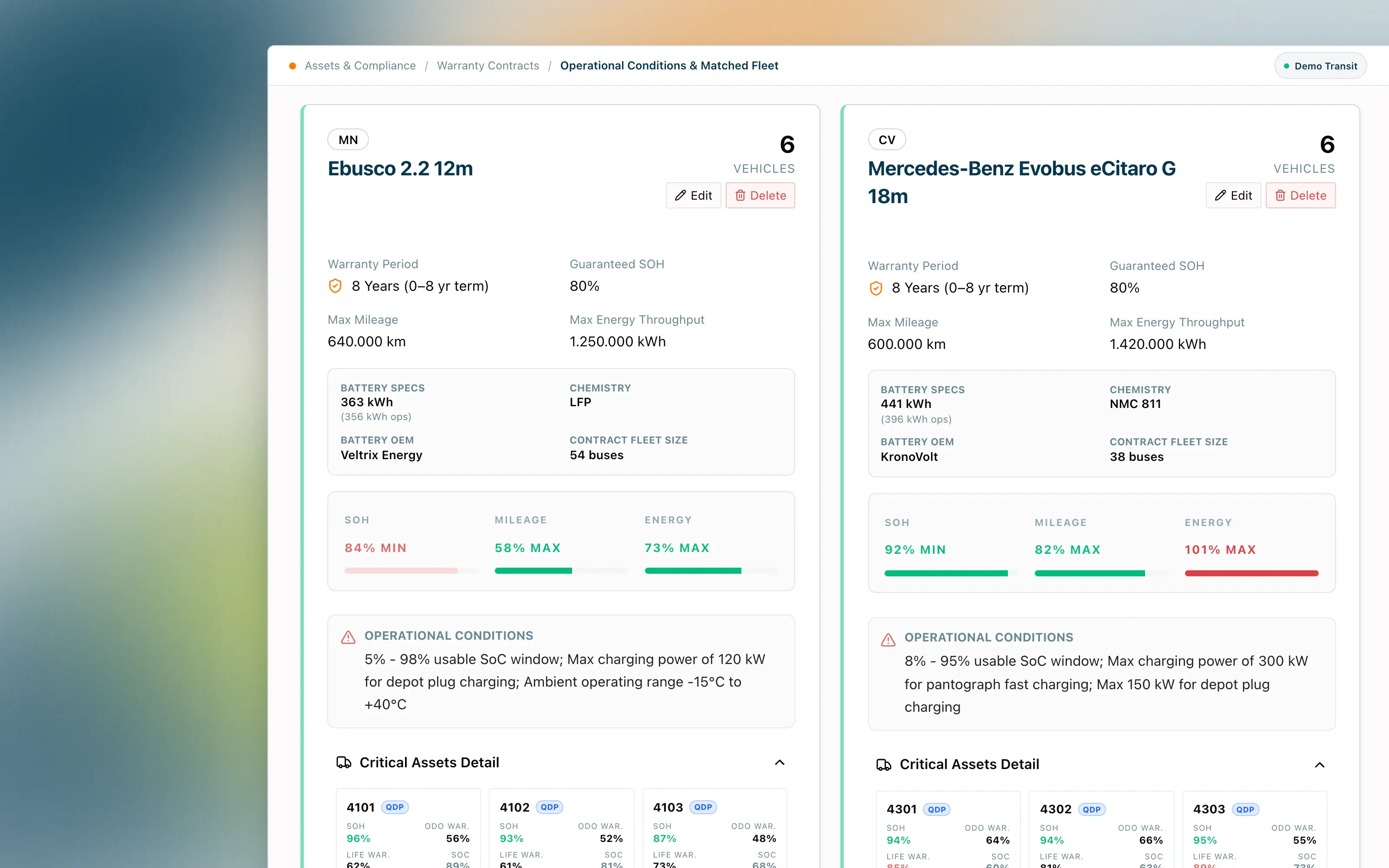
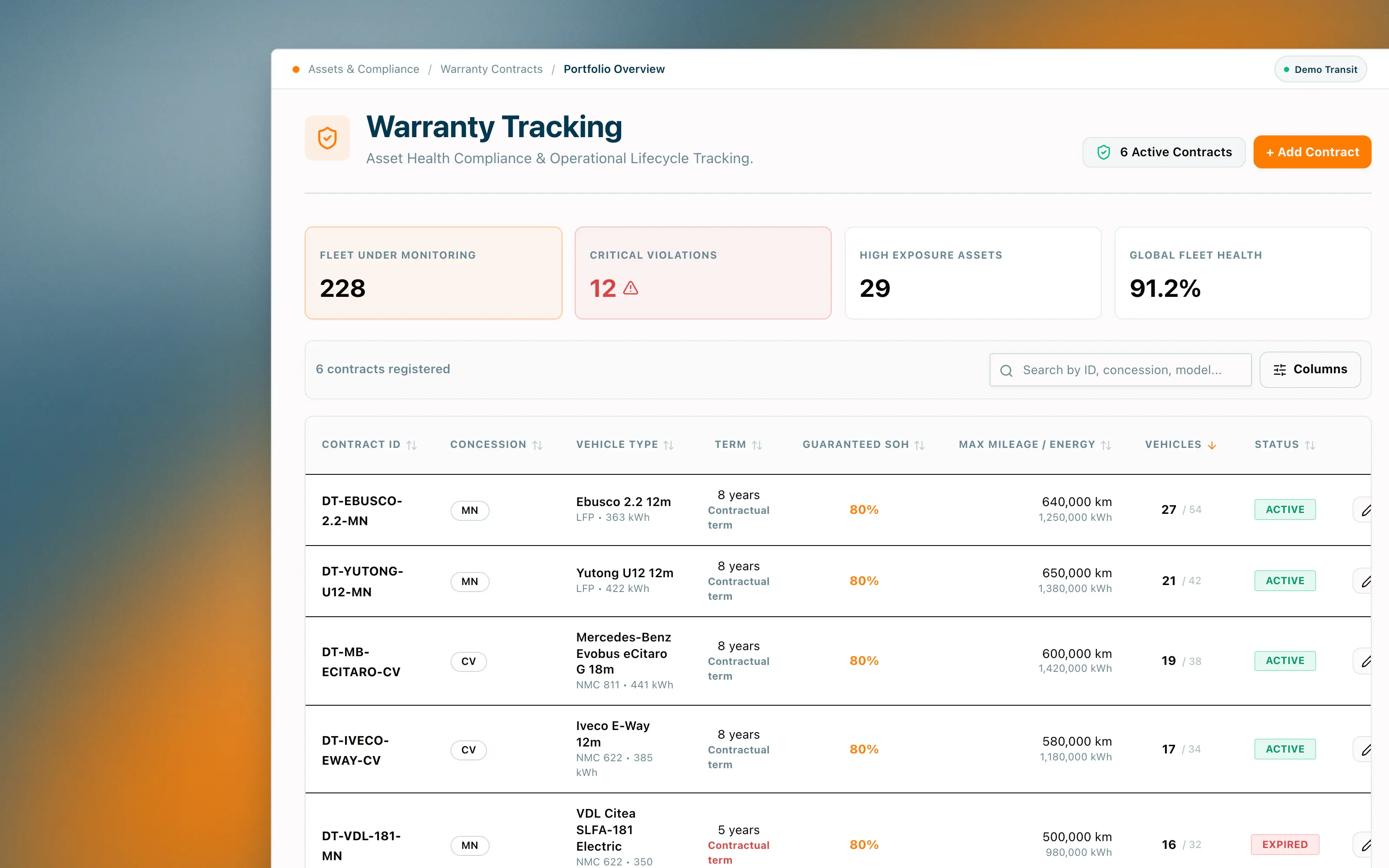
Centralise support agreements
Maintain every fleet support agreement in a single view matched directly to vehicle IDs. Track contract expiry dates, guaranteed state of health, maximum mileage, maximum kWh throughput, and battery specifications alongside live fleet summary metrics. Expired contracts retain their historical data for future procurement negotiations.
Track fine-print operational conditions
Convert complex contract annexes, such as usable charge windows, fast-charging caps and average depot power limits, into monitor rules.
Display operating limits side-by-side with real telemetry to identify potential clause breaches before submitting a formal claim.
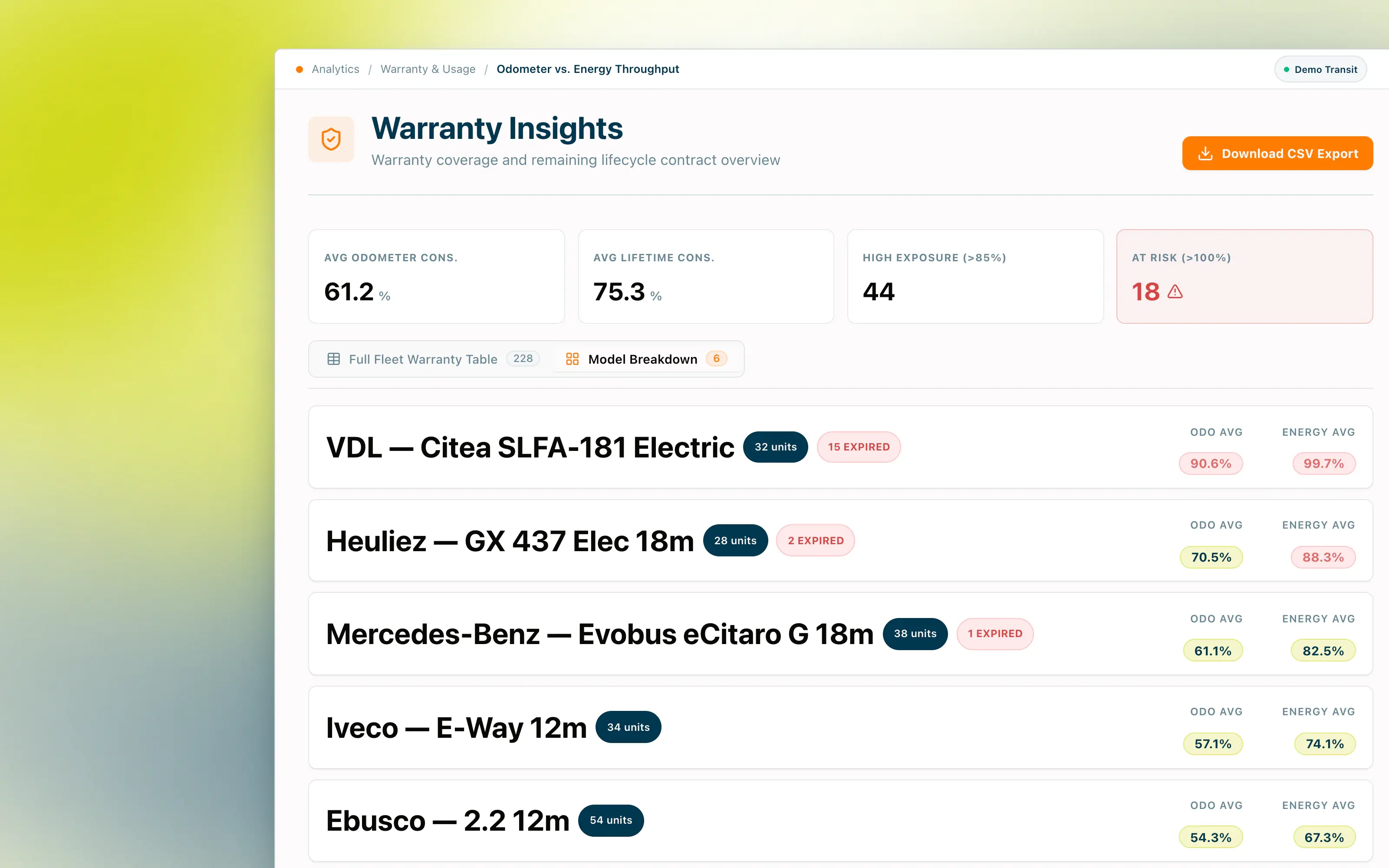
Monitor fleet consumption gaps
Compare mileage used against lifetime energy throughput across manufacturers, models and individual vehicles. See which vehicles are using their energy allowance much faster than their mileage allowance.
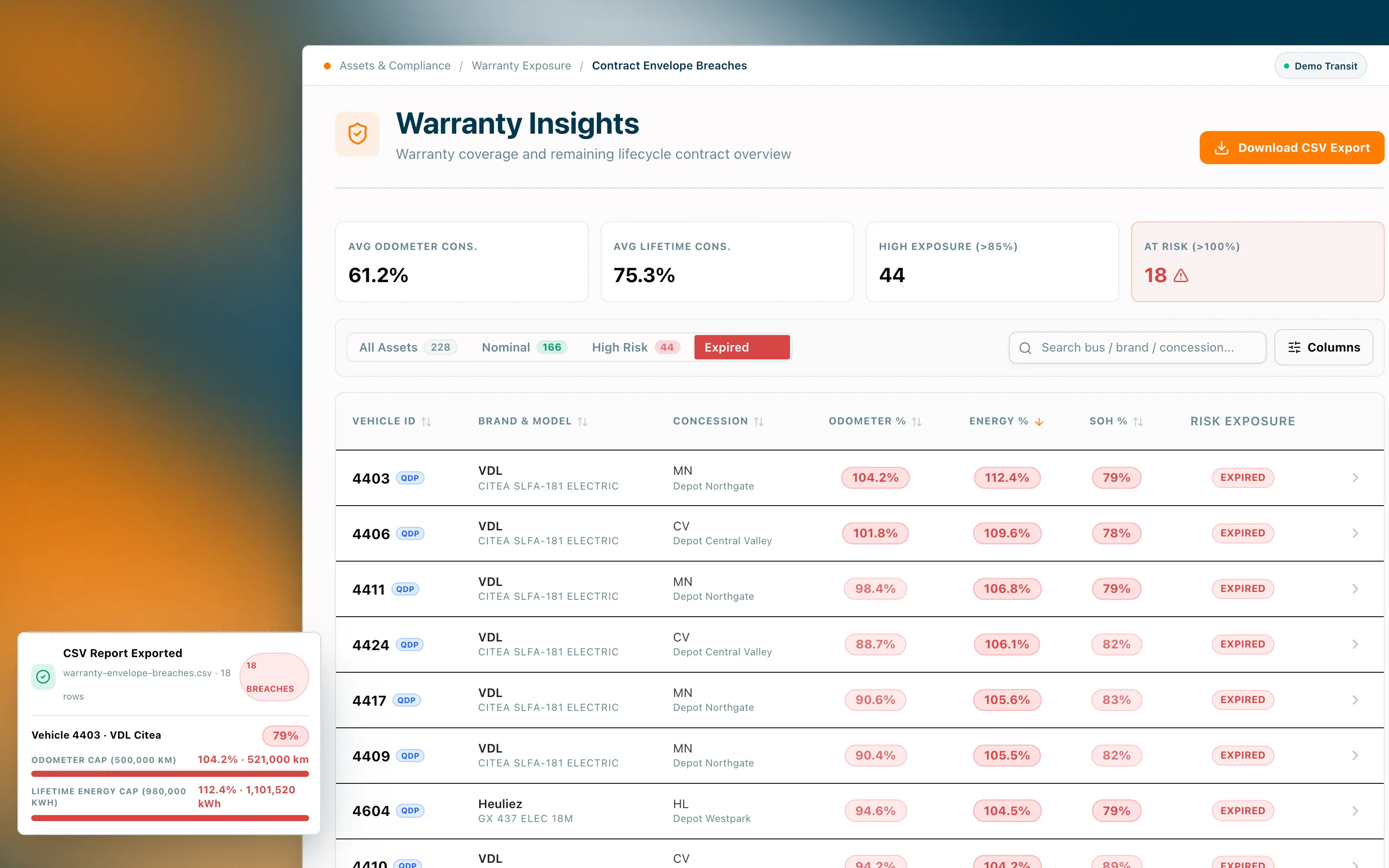
Flag envelope violations for negotiations
Automatically highlight vehicles that have exceeded 100% of their energy or mileage allowances in red. Export comprehensive consumption reports to CSV for legal documentation, renewal discussions, or upcoming tender specifications.
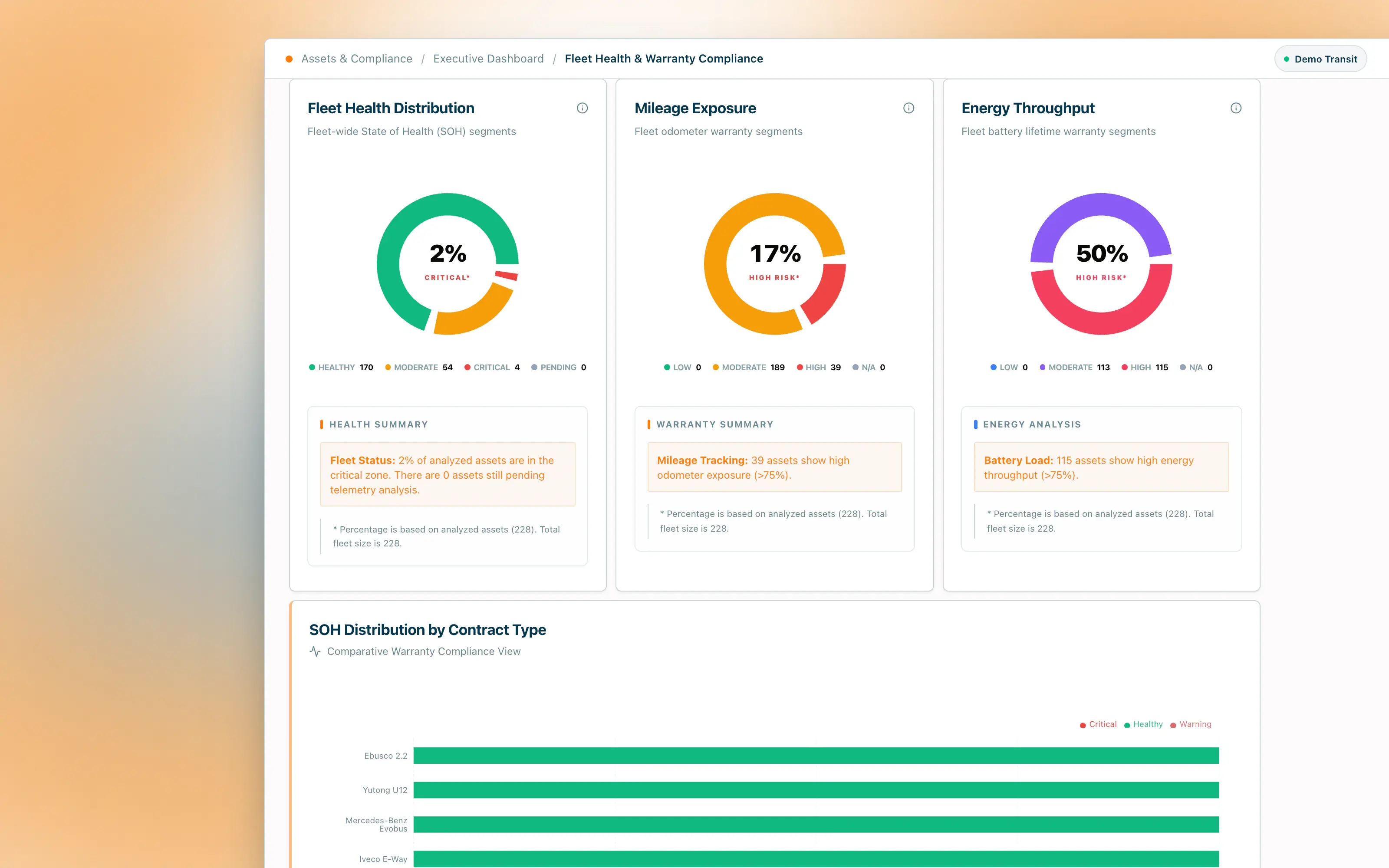
Generate board-ready compliance reports
Configure the long-term dashboard horizon to display fleet-wide health, mileage exposure, and energy throughput distributions. Group assets by specific contract types to evaluate performance against individual guarantee thresholds.
Why this is needed with a new fleet
Warranty problems can start on new vehicles too. When one does, the claim depends on records from before the problem started. Those records only exist if you began keeping them on day one.
"When a supplier resets the onboard system during maintenance, their count starts fresh. Ours does not. The degradation history stays intact."
After a reset, the onboard system no longer shows the pack's full history. Qera's record still runs from the day the vehicle was connected, and that is the history a warranty claim needs.
What data is required to run warranty tracking
Four things:
- Raw voltage and current
- The manufacturer's state of charge
- Energy throughput in kWh
- Your warranty terms
That is it. Your right to the raw data is settled EU law, and we help you exercise it during onboarding.

Frequently asked questions
What is a battery warranty threshold?
The performance level the OEM guarantees, typically defined by mileage, total energy throughput and minimum state of health. Falling below it within the term entitles the operator to a remedy.
What evidence do we need to win a battery warranty claim?
An independent, continuous record of the pack's state of health and usage, starting before the underperformance appeared. Data produced by the OEM's own system is weaker evidence, because the OEM controls it.
What happens to our data when the supplier resets the onboard system?
Nothing. Maintenance resets do not interrupt the degradation history, because our record runs independently of the vehicle's onboard system.
How much is a warranty claim worth?
A single won claim can cover a replacement pack of roughly €100k, which is often more than a year of software cost for the entire fleet.
Do you track the operational conditions in the contract, not just the headline numbers?
Yes. Usable charge windows, maximum charging power, C-rate limits and depot charging averages sit on each contract card alongside actual consumption.
Can we track warranties across different manufacturers at once?
Yes. Each agreement holds its own thresholds and conditions, and every vehicle is measured against the contract it was actually sold under.
What happens when a warranty expires?
The contract stays visible with an expired badge and its consumption history intact. The buses keep running, and the record is what the next agreement gets negotiated from.
We are mid-way through our warranty period. Is it too late to start?
No, and it is the most common starting point. We begin the independent record from the day you connect, and we reconstruct what we can from the history you already hold. Every day after that is evidence you did not have before.
Explore Qera Battery Intelligence
Operational control
Real-time charge and health, online pack monitoring, safety alerts, a live map and depot overview, across all your depots and makes.

Advanced analysis
True state of health for every pack, ranked by model, with health trends over time and a replacement window for each pack.